A retirement Monte Carlo analysis reports the odds your money lasts, not a single ending balance. Our other Monte Carlo guides each take one piece of that answer. One covers what counts as a good success rate and how to read your own, and one covers why the order of returns matters. This article runs the analysis itself, end to end. We enter one retired couple into our free calculator, press Run, and read every number that comes back.
The couple we entered
The test case is deliberately plain. Both spouses are 65, retired this year, and filing jointly. Entering them takes two tabs. Ages, retirement spending, and Social Security go on the Profile tab, with each spouse's Social Security card switched to Manual so the benefit comes straight off an ssa.gov statement. The three accounts go on the Assets tab.
| Input | Value |
|---|---|
| His 401(k) | $500,000, traditional, 7% expected growth |
| Her rollover IRA | $250,000, traditional, 7% |
| Joint brokerage | $150,000, taxable, 6.5% |
| Retirement spending | $5,200 a month in today's dollars |
| Social Security | $2,300 a month for him, $1,500 for her, both claiming at 67 |
| Lifespan setting | 95 for both |
The engine handles the rest without further input. It inflates spending and both benefit checks at 2.5% a year, reads 12% annual volatility onto the three accounts from their labels, spends the brokerage before the retirement accounts, grosses every traditional withdrawal up for federal income tax, and starts required minimum distributions at 75.
What one press of Run returns
We set the SIMS dropdown to 1000, the maximum, and pressed Run. The success card reads 97%, meaning the portfolio sustained spending through age 95 in 970 of 1,000 simulations. A 97 is a count, not a grade. In the other 30 replays the accounts hit zero before 95, and the failures come late. In a 5,000-run batch through the same engine, the typical failing run went broke at 92 and the earliest went broke at 82.
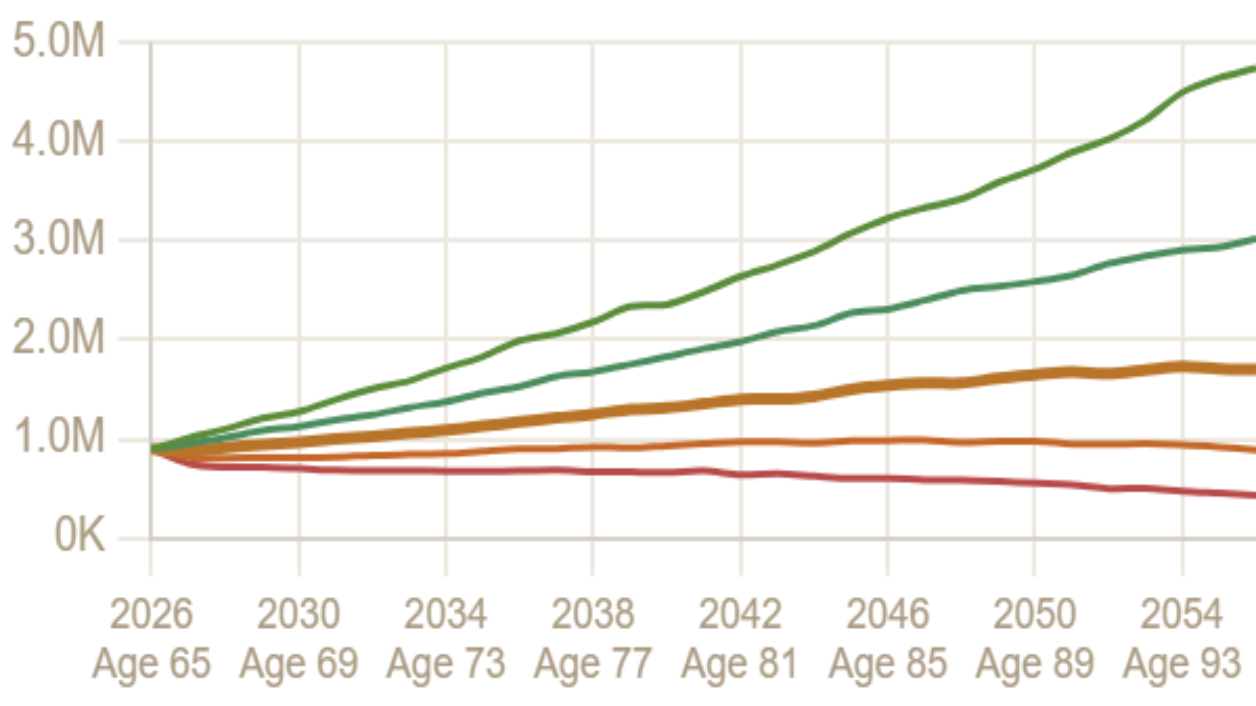
The fan chart under the headline number is the actual analysis. Every line starts from the same $900,000, and nothing differs between them except the order in which the market's good and bad years arrive. The 90th percentile path compounds past $6 million; the median ends near $1.73 million; even the 10th percentile path stays solvent, ending near $381,000. Only the bottom few percent of sequences run dry, and the gap between the best and worst survivors is entirely the order in which returns arrived. Our guide to sequence-of-returns risk covers why the order alone can do that.
The success rate is tied to the lifespan you chose
The success rate answers a question with an age inside it. We typed 95 into the two lifespan fields, so 97% is the chance the money outlasts both spouses at 95. Change the field and the same plan returns a different, equally correct answer. We ran it at three settings and touched nothing else. Figures in the table come from 5,000-run batches through the same engine.
| Lifespan setting | Success rate | Runs that go broke | Median ending balance | 10th percentile ending balance |
|---|---|---|---|---|
| 85 | 100% | Fewer than 1 in 200 | $1,500,000 | $602,000 |
| 90 | 99% | 1% | $1,620,000 | $538,000 |
| 95 | 97% | 3% | $1,730,000 | $381,000 |
The decay is gentle for this well-funded couple, whose two Social Security checks cover most of the budget. The five years from 85 to 90 cost one point, and 90 to 95 cost two. Even asked to reach 95, the plan goes broke in only 3 replays of 100, and at 85 it cannot realistically fail, with even the worst tenth of outcomes ending above $600,000. Longevity is still the one input nobody gets to know in advance, so run the analysis at more than one age and see how fast your own number decays, since a thinner plan decays much faster than this one.

The SIMS setting controls steadiness, not accuracy
Every press of Run draws fresh random sequences, so the reported rate wobbles between presses. The SIMS dropdown sets how much. We ran the plan-to-95 case twelve times at each of the calculator's four settings and kept the lowest and highest answer.
| SIMS setting | Twelve runs returned | Spread |
|---|---|---|
| 100 (Fast) | 93% to 100% | 7 points |
| 200 (Balanced) | 96% to 99% | 3 points |
| 500 (Precise) | 96% to 98% | 2 points |
| 1000 (Max) | 97% to 98% | 1 point |
The lesson is short. Use 1000 when the answer matters, expect to land within a couple of points of the figures in this article on identical inputs, and treat a one-point move between runs as noise rather than news.
What the number is for
A probability you can re-run in seconds is a dial, not a verdict. We went back to the Profile tab and made one change, cutting spending from $5,200 to $4,700 a month. The plan-to-95 success rate rose from 97% to 100%, the share of broke runs fell from 3% to none, and the median run ended even further ahead. This couple is already well inside the healthy band, so the cut mostly buys the last sliver of certainty and a larger estate rather than a big jump in the headline. A plan sitting lower in the band would see each $100 of monthly spending trade for far more. That exchange rate is the practical output of the whole analysis, and a single-number calculator cannot produce it. Our guide to a good Monte Carlo success rate covers what rate to aim for, how to read your own score, and when to act.
The bottom line
One plain couple and a few minutes of input returned a full picture. The plan reaches 95 in 97 replays of 100. Failure, when it happens, means running dry in the early 90s rather than at 80. Ten fewer years of lifespan makes the same plan airtight, and $500 a month of spending is the distance between 97% and a clean 100%. Every one of those figures responds to a setting you can see on screen. Run your own plan in the calculator, free and with no account, and read what comes back.
Sources
- Social Security Administration, Actuarial Life Table (context for the lifespan setting)
- RetirFi simulation methodology, described on our about page. Every figure in this article comes from the same engine that runs the calculator.
Read your own numbers.
Enter your accounts, spending, and Social Security, then run 1,000 simulations against your own lifespan. Free, no account.
Open the Calculator →