A Monte Carlo success rate is easy to misread as a test score, where 100% is an A and anything short of it counts against the plan. It is not a grade, and the right target is almost never 100%. This article runs one couple's plan through the calculator to show what number to actually aim for, how to read your own result against it, and why the retirement date moves the score more than any other lever.
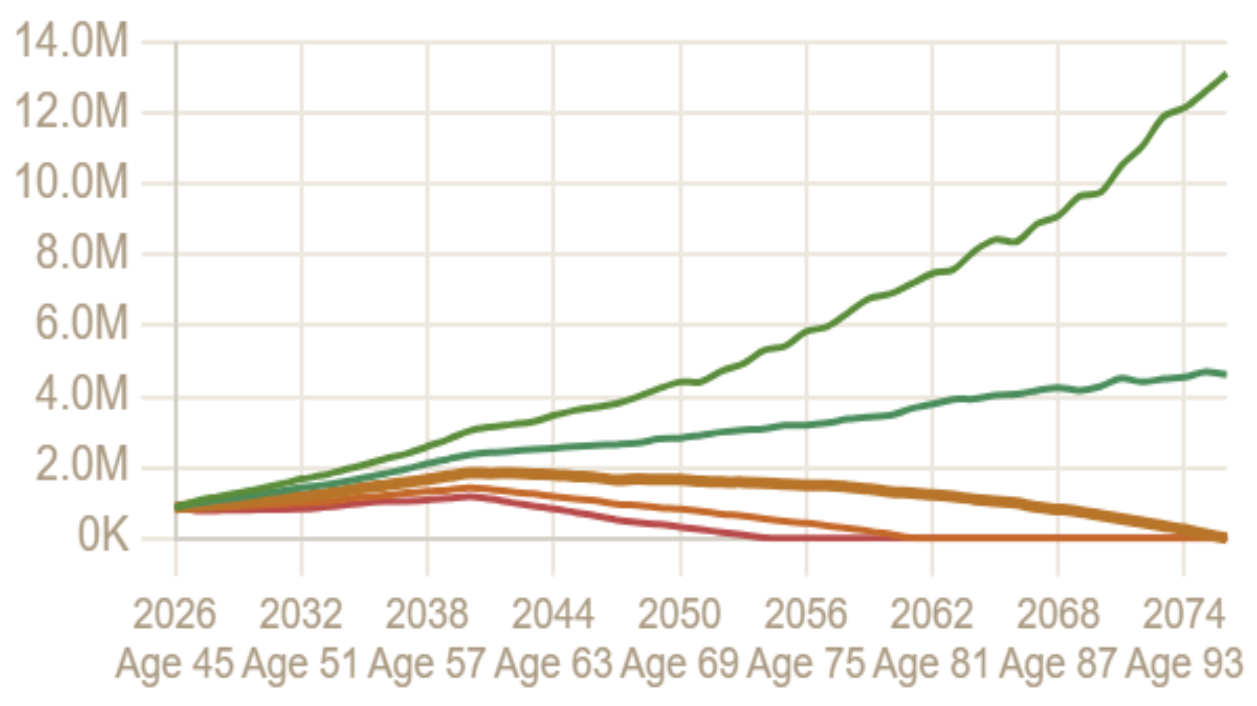
A married couple, both 45, holds $870,000 across a SEP-IRA, two Roth IRAs, a brokerage account, and cash, and is still saving $59,000 a year. Their plan spends $6,000 a month, claims Social Security at 67, and runs to age 95. The version they wanted, retiring at 55, scores 51%. The version that retires at 65 scores 87%. Same couple, same money, same budget, but ten working years separate a plan in trouble from a plan in the healthy band. Below, we'll go through the math.
The 80–90% convention
The success rate is the share of simulated futures in which your money lasts to the age you set. A plan that survives 850 of 1,000 scenarios reports 85%. The other 150 are runs where the portfolio ran dry early, and they are concentrated among the sequences where retirement starts with a market crash. Our walkthrough of a full Monte Carlo analysis reads every number the calculator returns. This article takes up the narrower question of what number to aim for.
This sample couple's 87% means that in 87 of every 100 simulated lifetimes, their money lasts until age 95. In the 13 that fail, the portfolio gives out at a median age of 88, well into the plan's final decade.

Many financial advisors recommend a target in the 75–90% range, with 80–90% as the band most planning software and most advisors treat as healthy. The convention follows from two facts about the simulation. First, the failed runs are not spread evenly across ordinary futures. Those situations are the extremes, the sequences that pair a deep early crash with years of higher inflation. Second, the simulation assumes you never react. Every failed run is a future in which you kept withdrawing the same inflation-adjusted amount while your portfolio fell apart for a decade. Reality does not behave that way. Michael Kitces, one of the most widely cited researchers on Monte Carlo use in financial planning, has argued the metric is better read as a "probability of adjustment." A failed run is not a future where you go broke, but a future where you would have had to cut back for a while.
The target band. 80–90%. Below 80%, modest changes now buy real safety. Above 90%, each extra point mostly buys money you will not live to spend.
Why 100% is the wrong goal
A 100% score requires your plan to survive every sequence the model can produce, including tails worse than anything in market history. The model stress tests those extremes intentionally. You want to see under what circumstances your plan fails. And your plan surviving those extremes usually means you are underspending and could have a more fruitful retirement.
The math makes the trade concrete. As a rough rule, pushing a typical 30-year plan from around 90% to around 99% means cutting the withdrawal rate by close to a percentage point, say from 4% to 3%. On a $1 million portfolio that is $10,000 less to live on every year of retirement. That could be two more vacations per year. Or one extra luxury vacation per year. Or some charitable giving. The cut applies in all 1,000 simulated futures, but it only matters in the hundred or so where the bad sequence shows up. In roughly nine futures out of ten you paid the premium and never needed it, and the unused premium appears at the end of the plan as a large balance you did not spend.
The couple's numbers show the unused premium directly. Cut their spending to $5,500 a month and the plan scores 92%, but the median run now ends at age 95 with about $6.6 million unspent, roughly seven times what they hold today. The extra safety is real. So is the $500 a month they never spent across three decades.
Now, that doesn't mean they have to spend another $6.6 million in their lifetime. But they could've done more fine dining, traveled the world, bought a vacation home, gone to the Super Bowl. Name your bucket list item.
A 99% plan therefore usually means retiring later than necessary or spending less than the portfolio could support. Underspending has a cost too. It is just one that never shows up in the simulation.
Where in the band your target should sit
Failure in the simulation means the portfolio could not fund the FULL budget, every year, to the end of the plan. How bad that outcome would be for you in practice is what sets your target.
How strong your guaranteed income floor is
Social Security keeps paying whatever the market does, and so does a pension. If that floor covers your essential expenses, a depleted portfolio means losing extras rather than the necessities. If the floor covers only a small share of essentials, portfolio failure is a much harder landing, and the target should move up accordingly. Claiming decisions interact with the target for the same reason. Delaying Social Security raises the floor for life, which lets you accept a lower score on the portfolio side. The head-to-head test below prices that trade for our couple, and the result is not what the conventional advice predicts.
How long the plan has to run
A 30-year horizon is the well-studied case. A 45- or 50-year horizon, the kind an early retiree needs, gives tail risks more time to appear and assumptions more time to drift. It also gives you more room to adapt, since a 45-year-old can return to work in a way a 75-year-old cannot. On balance the longer horizon argues for a higher target and for re-running the plan more often. Our piece on the 4% rule and early retirement works through why long horizons punish fixed withdrawal rules.
The couple's retire-at-55 dream shows what the longer horizon costs. Retiring at 55 instead of 65 means ten fewer years of contributions, ten more years of withdrawals, a twelve-year wait for Social Security, and a forty-year retirement instead of thirty. The score drops from 87% to 51%, and the failures get uglier. Nearly half the runs deplete, at a median age of 81 and in the worst sequences in their mid-60s, barely a decade in. Retirement age is the single heaviest input in their plan, worth roughly three to four points per year.
| Situation | Reasonable target |
|---|---|
| Guaranteed income covers essentials; spending has real slack | 75–85% |
| Typical mix of fixed and flexible spending | 80–90% |
| Tight budget, thin guaranteed income floor | 85–95% |
| Retiring in your 40s or early 50s | 85–95%, re-run yearly |
Three fixes, head to head
Suppose the couple wants more margin than 87%, or wants to claw back some of the early-retirement dream. The standard fixes are to spend less, work longer, or delay Social Security, and every adviser has a favorite. The simulation can price all three against each other before anyone commits to anything. Each version below changes exactly one input on the retire-at-65 baseline.
| The fix | Success rate | Points gained | Median ending balance |
|---|---|---|---|
| Baseline (retire 65, spend $6,000/mo, claim at 67) | 87% | baseline | $5,760,000 |
| Work two more years (retire at 67) | 92% | +5 | $7,250,000 |
| Cut spending $500/mo (to $5,500) | 92% | +5 | $6,580,000 |
| Delay Social Security to 70 | 86% | −1 | $5,370,000 |
Working longer and spending less land close together, and both work through the same mechanism. Each extra working year adds $59,000 of contributions on the way in and removes a year of withdrawals on the way out; each $500 of monthly spending cut removes $6,000 of withdrawals every year for three decades, and in the bad sequences the stocks you did not sell at the bottom are the stocks that recover.
The Social Security delay buys nothing at all, and that result deserves attention because delaying is the fix with the best press. Waiting until 70 raises the couple's combined benefit from $4,400 to $5,456 a month, a 24% raise that lasts for life and rises with inflation. But the delay also leaves the portfolio funding the entire budget for five years with no benefit coming in instead of two, and those bridge years land exactly where a bad market does its worst damage. The bigger checks arrive after the failing runs are already broke; the score does not move up at all, and if anything slips a point, from 87% to 86%, while the worst tenth of the delayed plan's futures still ends at $0. Delaying can still be a good trade for the income floor it builds, especially for whichever spouse outlives the other. It is just not a way to move the headline number.
Two plans with the same score are not equally safe
The couple's five plans show the range of what a score can hide. In the 87% baseline, the failed runs give out at a median age of 88, with the earliest at 72. In the 51% retire-at-55 version, failures come at a median age of 81 and as early as their mid-60s. And at 92%, even the 10th-percentile run finishes with roughly $300,000 still invested, while the 87% baseline's 10th percentile ends at $0.
So look underneath the score. Check what age the failed runs give out at, and where the median path ends up. Most failures trace to the same mechanism, weak returns in the first several years of withdrawals, when each dollar sold is sold cheap. Our article on sequence-of-returns risk shows the mechanics with two retirees who earn identical average returns in opposite order and end up in opposite places.
Differences of a point or two are noise
At around 1,000 runs, a Monte Carlo result settles to within a point or two of itself. Re-run the same plan and 86% may come back as 85% or 87%. That wiggle is sampling error, not a change in your retirement. The couple's baseline behaves the same way. Re-running the identical plan at 1,000 simulations came back anywhere from 86% to 89% across several consecutive runs, while longer 8,000-run batches settle at 87%. Nothing changed but the random draws. It follows that fine-tuning a plan to move the score from 86 to 88 is engineering inside the margin of error. Read scores in bands. A move from 72 to 84 is signal. A move from 84 to 86 is not.
How to interpret your own success rate
Once you have your own number, read it as a band rather than a precise grade. The ranges below map what a score usually signals and what it asks you to do about it.
| Success rate | What it usually signals |
|---|---|
| 95–100% | Likely underspending. Room to spend more, retire earlier, or give and leave more. |
| 80–90% | The healthy target. Resilient to bad markets, with built-in room to adjust. |
| 65–80% | Workable but worth watching. Small changes now meaningfully improve the odds. |
| Below 65% | The plan needs a real adjustment to spending, timing, or savings. |
Whatever band you land in, the score is not a verdict stamped on your retirement. It is a snapshot of one set of assumptions on one day. Markets move, your spending changes, tax law shifts, and your goals evolve, so the plan is meant to move with them. Re-run it once a year and after any major financial change, and treat the number as a signal to steer by, not a final grade.
The bottom line
Aim for 80–90%. Sit low in the band if your spending has slack and guaranteed income covers your essentials; sit high if your budget is rigid, your floor is thin, or your horizon is unusually long. Above roughly 95%, the more useful reading is that you can spend more or retire sooner. Below roughly 75%, adjust a lever, whether spending, retirement date, savings rate, or claiming age. And price the levers against each other before you commit to one. On our couple's plan, retirement age moved the score three to four points a year, the spending cut bought five, and the celebrated Social Security delay bought nothing at all.
The target only means something once you have your own number. Run your plan through the calculator, see where it lands, and test which lever moves it the most. The Monte Carlo guide covers the mechanics behind the score if you want to see how the runs are built.
Sources
- Philip L. Cooley, Carl M. Hubbard, and Daniel T. Walz, "Retirement Savings: Choosing a Withdrawal Rate That Is Sustainable," AAII Journal, 1998 (the Trinity study).
- William P. Bengen, "Determining Withdrawal Rates Using Historical Data," Journal of Financial Planning, 1994.
- Michael Kitces, Nerd's Eye View, research on Monte Carlo success rates and retirement spending adjustments.
- RetirFi simulation methodology, described on our about page; scenario figures come from the same engine that runs the calculator.
Find your own success rate.
Run a Monte Carlo simulation on your numbers, see where you land against the 80–90% band, and test which lever buys the most points.
Open the Calculator →